Quick answer
To pack a kitchen for moving, start a few weeks early with the items you rarely use, wrap every plate and glass on its own in packing paper, stand plates on edge in a sturdy dish box, fill every gap so nothing can shift, and keep one small box of everyday essentials to pack last.
In this guide
Kitchen packing supplies you need
Good materials do most of the work. Gather these before you start:
- Dish boxes. Double-walled boxes made for plates and glassware
- Small and medium boxes. Small for heavy items like cans and cookbooks, medium for pots and appliances
- Packing paper. More than you think. Plain paper, not newspaper, which leaves ink on dishes
- Bubble wrap for the most delicate pieces
- Packing tape and a thick marker
- Zip-top bags for small parts, lids, and hardware
Our packing estimator tells you how many boxes a home your size needs.
Do not skimp on paper. A kitchen uses more of it than any other room, and running out halfway through a cabinet is how plates end up wrapped in a single thin sheet. Buy dish boxes new rather than reusing grocery boxes, which are not built to be stacked. If you book our packing services, the boxes, paper, bubble wrap, and tape are included in the quote.
The order to pack a kitchen in
- Sort first. Donate duplicates, chipped dishes, and gadgets you never use. Toss expired food
- Three to four weeks out: pack what you rarely use: serving platters, holiday dishes, specialty appliances, cookbooks, vases
- One to two weeks out: pack most of the dishes, glasses, pots, and pantry items
- The last two days: pack the everyday set, the coffee maker, and the fridge contents
Set aside an essentials box: a plate, bowl, cup, and utensils for each person, one pot, one pan, a knife, a sponge, dish soap, and paper towels. It gets packed last and opened first.
Work one cabinet or drawer at a time and finish it before you open the next. Write the room and the contents on every box, such as kitchen, everyday plates, so you can find the coffee mugs on the first morning without opening ten boxes. For the last week, plan simple meals and switch to paper plates so the final boxes can be sealed early.
How to pack dishes for moving
- Line the bottom of a dish box with several inches of crumpled packing paper
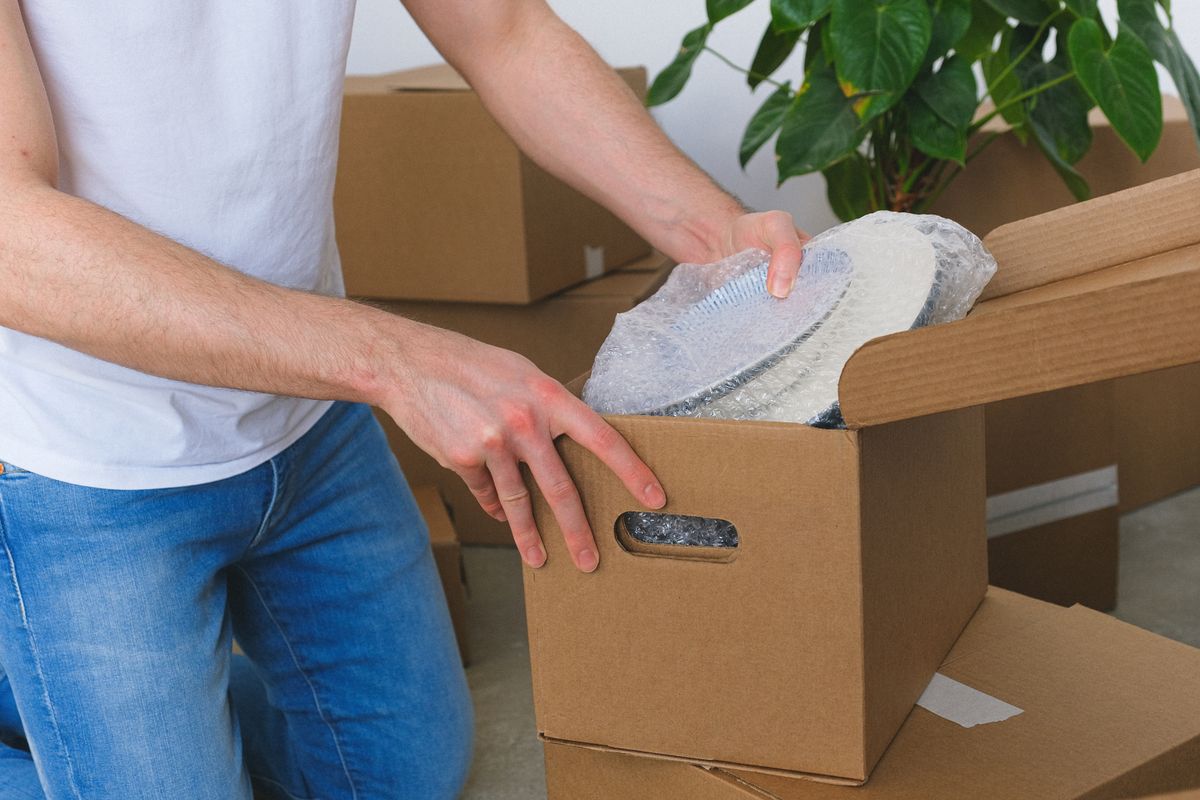
- Wrap each plate on its own in a sheet or two of paper
- Stack three or four wrapped plates and wrap the bundle once more
- Stand the bundles on edge in the box, like records. Plates packed flat crack under their own weight
- Fill every gap with crumpled paper, add a thick layer on top, and close the box. If you can hear anything move when you shake it gently, add more paper
- Mark the box fragile and this side up on the top and at least one side
Bowls pack the same way, nested in twos or threes with paper between each one.
Keep each box light enough to lift without strain. Plates are heavier than they look, so a dish box full of stoneware may need a top layer of lighter items, such as plastic containers, instead of more plates. Wrap serving platters and large bowls one at a time and stand them on edge as well. Fine china deserves a layer of bubble wrap over the paper.

How to pack glasses and stemware
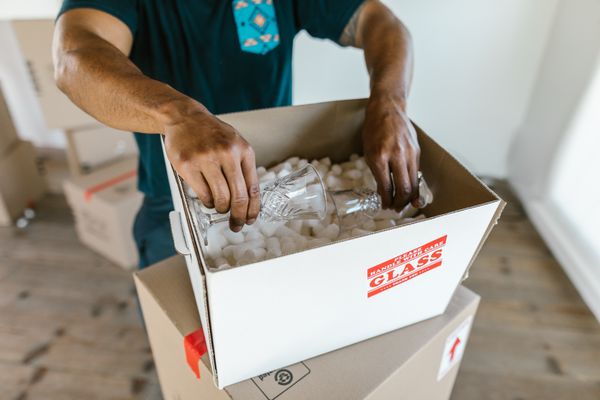
Stuff a little crumpled paper inside each glass, then roll it in a full sheet and tuck in the ends. Stand glasses upright, never on their sides, with the heaviest on the bottom layer. Wrap stems first with a twist of paper before wrapping the whole glass. Cardboard cell dividers are worth using if you have a lot of stemware.
The same method answers how to pack glasses for moving of every kind. For mugs, wrap the handle first with a strip of paper, then roll the mug in a full sheet. Put a flat layer of paper or a sheet of cardboard between each layer of glasses, and stop one layer short of the top so you can add a thick cushion before you close the box. Never put anything heavy on top of glassware, in the box or in the stack.
Short on time? Our crew can pack the whole kitchen, or just the fragile items, with all materials included.
Pots, pans, and bakeware
Nest pots and pans by size with a sheet of paper between each to protect the finish. Wrap glass lids separately like plates. Baking sheets and cutting boards can stand on edge along the side of a medium box.
Packing pots and pans is the easy part of the kitchen, because most of them cannot break. Use that to your advantage: tuck spice jars, dish towels, or small utensils inside the pots to save space. Cast iron is the exception on weight, so give it a small box of its own. Wrap glass baking dishes and ceramic casseroles the way you wrap plates, and never nest them without paper in between.
Knives and utensils
Roll knives in packing paper, then in a dish towel, tape the bundle shut, and label it clearly. Pack them flat on their sides, never pointing up. Everyday utensils can stay in their tray: wrap the whole tray in paper or plastic wrap and lay it flat in a box.
A knife block can travel with the knives in it. Wrap the whole block tightly in plastic wrap, or tape a towel around it, so nothing slides out. Treat graters, peelers, pizza cutters, and food processor blades as knives too, and write sharp on the outside of the box for whoever unpacks it.
Small appliances
Use the original box if you kept it. If not, remove loose parts and blades, wrap them separately, tape cords to the appliance, and pack each one in a snug box with paper on every side. Empty and dry coffee makers and kettles the night before.
A few specifics on how to pack small appliances:
- Microwave. Take out the glass tray, wrap it like a plate, and pack it separately. Tape the door shut
- Stand mixer. Heavy for its size. Use a small, sturdy box and pack the bowl and attachments around it
- Blender and food processor. Wrap glass jars like glasses and blades like knives
- Toaster and toaster oven. Shake out the crumbs first
The refrigerator needs its own lead time: empty it, defrost it, and dry it at least 24 hours before the move.
Pantry, spices, and liquids
Pack cans and jars in small boxes so they stay liftable. Tape the lids of anything that can spill, stand bottles upright in a box lined with a trash bag, and keep liquids separate from dry goods. Leave behind anything open that is not worth the risk of a leak.
Cleaning chemicals and anything flammable should not go on the truck at all. See our list of what movers won't move.
Not everything in the pantry is worth moving. Eat down what you can in the last few weeks and donate unopened, shelf-stable food you will not use.
If the kitchen is the room you are dreading, you do not have to pack it yourself. Allpoints crews can pack the whole kitchen or only the breakables, and you can add it when you request a free quote.
Key takeaways
- Start with what you rarely use and pack the everyday set last
- Wrap every piece on its own and stand plates on edge
- Fill every gap. Empty space is what breaks dishes
- Small boxes for heavy things, dish boxes for breakables
- Keep an essentials box out for the last night and the first morning