Quick answer
To move a fish tank, stop feeding the fish a day or two ahead, move them yourself in bags or lidded buckets of tank water, keep the filter media wet, then drain the tank completely and pack it empty. Set the aquarium up first at the new home and acclimate the fish slowly.
In this guide
- Can movers move a fish tank?
- Supplies for moving an aquarium
- How to move a fish tank: what to do before moving day
- How to transport fish when moving
- How to keep the aquarium beneficial bacteria alive
- How to pack a fish tank and its equipment
- Setting up the tank at your new home
- Moving fish long distance
- Frequently asked questions
Can movers move a fish tank?
Movers can move the tank itself, the stand, the hood, and the boxed equipment, as long as the aquarium is completely empty, clean, and dry. What does not go on the truck is anything alive or wet: fish, invertebrates, live plants, and water. Like other pets, fish travel with you. Our guide to what movers won't move explains why.
That splits the job in two. You handle the livestock and the water. The crew handles the glass, the stand, and the heavy lifting. If you want the tank professionally wrapped and padded, ask about it when you request your local moving quote.
Supplies for moving an aquarium
Gather everything a few days ahead. Use containers that have never held soap, detergent, or chemicals.
- Fish bags or clean lidded buckets for the fish
- An insulated cooler or foam box to hold temperature and keep the fish in the dark
- Extra lidded buckets or water jugs for saved tank water
- A siphon hose and a fish net (two nets make catching easier)
- Zip-top bags for filter media and live plants
- Water conditioner (dechlorinator) and a water test kit for the new home
- A battery-powered air pump if the trip will last more than an hour or so
- Moving blankets, bubble wrap, and a sturdy box for the tank and equipment
How to move a fish tank: what to do before moving day
- Plan the tank as its own project. It should be the last thing taken down at the old home and the first thing set up at the new one
- Choose the new spot in advance. You need a level floor, an outlet nearby, and no direct sun or heating vent
- Stop feeding one to two days before. Aquarium suppliers generally recommend this so the fish produce less waste in a small volume of water. Healthy adult fish handle a short fast well, but ask a local aquarium shop if you keep delicate species or fry
- Do not deep clean the filter or gravel. Scrubbing them right before a move removes the bacteria you are about to work hard to save
- Unplug the heater about 30 minutes before you start. A hot heater lifted out of the water can crack
How to transport fish when moving
- Save water first. Siphon tank water into your clean buckets and jugs before you stir up the bottom. Clean water makes the fish easier to catch too
- Lift out decorations and rocks slowly so nothing is hiding inside them
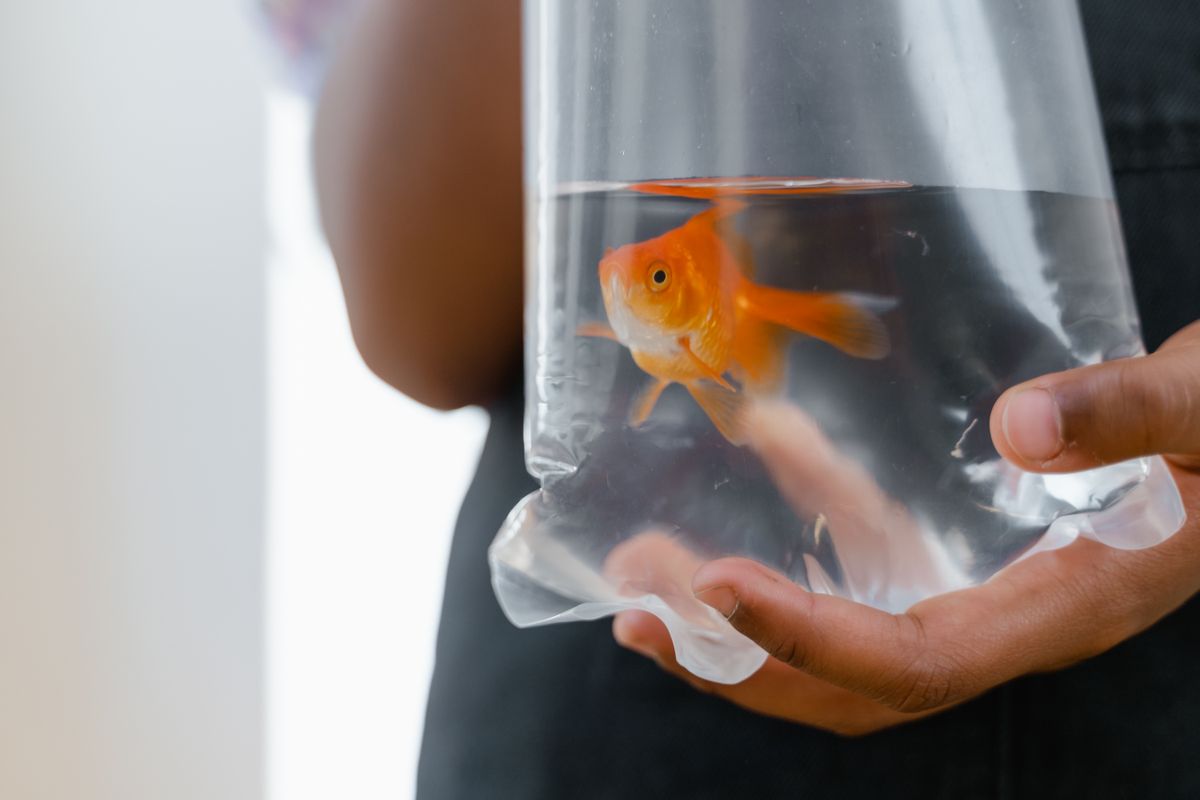
- Catch the fish gently and place them in bags or buckets of tank water. In a bag, use roughly one third water and two thirds air, then seal it with a rubber band and double-bag it
- Separate fish that fight or have sharp spines. Peaceful schooling fish can share a container with their own kind
- Put the bags or buckets in the cooler and close the lid. Darkness keeps fish calm and the insulation keeps the temperature steady
- Keep the cooler with you in the climate-controlled part of your vehicle, never in a trunk or a hot parked car
For a short drive across town, sealed bags or lidded buckets are usually enough. If the fish will be contained for more than an hour or so, add a battery-powered air pump to a bucket, or ask an aquarium shop to bag the fish with oxygen.
We will wrap, pad, and carry the empty tank and stand while you look after the fish. Get a free, no-obligation moving quote.
How to keep the aquarium beneficial bacteria alive
An established tank is safe for fish because colonies of beneficial bacteria break down the ammonia in fish waste. Those bacteria live mainly on surfaces: the filter media, the gravel or sand, and the decorations. Lose them and the tank has to cycle again from scratch, which is hard on fish.
- Keep the filter media wet. Pack sponges, ceramic rings, and cartridges in a bag or bucket with tank water. Do not rinse them in tap water and do not let them dry out
- Keep the substrate damp. Scoop gravel or sand into buckets with a little tank water over it. Spread the weight across several buckets
- Save as much tank water as you can carry. Reusing it means the fish return to water chemistry they already know
- Avoid temperature extremes and get the filter running again as soon as you can. The bacteria need oxygenated water moving past them
How to pack a fish tank and its equipment
Never move a tank with water, gravel, or rocks left inside. Glass and acrylic tanks are built to hold weight while sitting still on a level surface, not while being tilted and carried. Weight left inside can stress the seams and crack the bottom panel.
- Drain the tank completely and remove all substrate
- Wipe the inside with a clean cloth and plain water. No soap or glass cleaner on the inside
- Wrap the heater, filter, pump, and light separately and box them like fragile electronics
- Tape the lid or hood shut, or pack it on its own
- Wrap the tank in moving blankets or bubble wrap and keep it upright and flat on its base
- Empty the stand and move it separately
Large tanks are heavy and awkward even when empty. This is a good piece to hand to the crew. Our packing services cover fragile and oversized items, with materials included in the quote.
Setting up the tank at your new home
- Place the stand, check that it is level, and set the empty tank on it
- Add the substrate, then pour in the saved tank water
- Top off with tap water treated with dechlorinator and matched as closely as you can to the tank's temperature
- Reinstall the filter with its wet media, then the heater. Wait until the heater is fully under water before plugging it in
- Add a few decorations so the fish have somewhere to hide
- Float the sealed bags in the tank and add a little tank water to them about every 10 minutes for around 45 minutes, then release the fish with the lights off
Do not feed on moving day. Over the next few weeks, test for ammonia and nitrite, feed lightly, and hold off on adding new fish until the readings are steady.
Moving fish long distance
A move across town is a few hours of stress. A multi-day long-distance move is a different problem, because fish in small containers run short of oxygen and clean water. Your realistic options:
- Drive them yourself in an insulated container with battery aeration, and bring them into the hotel room overnight
- Ask a local aquarium shop whether it can hold your fish and ship them to you once the tank is running
- Rehome the fish with a hobbyist or a shop and restock after the move. For large or sensitive species, this is sometimes the kindest choice
Saltwater and reef tanks, and any rare or sensitive species, need more specific advice than a general guide can give. Talk to an aquarium specialist or an aquatic veterinarian before you plan the trip. For the rest of the household, our moving checklist keeps the other tasks on schedule.
Key takeaways
- Fish, plants, and water travel with you. The empty tank, stand, and equipment can go on the truck
- Stop feeding one to two days before the move and do not deep clean the filter
- Keep filter media and substrate wet in tank water to protect the beneficial bacteria
- Drain the tank completely. Never move it with water or gravel inside
- Set the aquarium up first at the new home and acclimate the fish slowly with the lights off