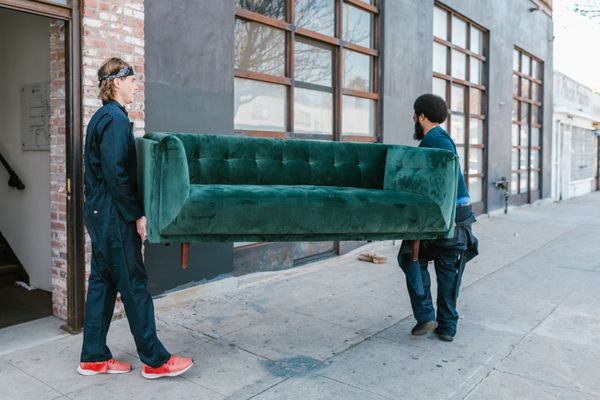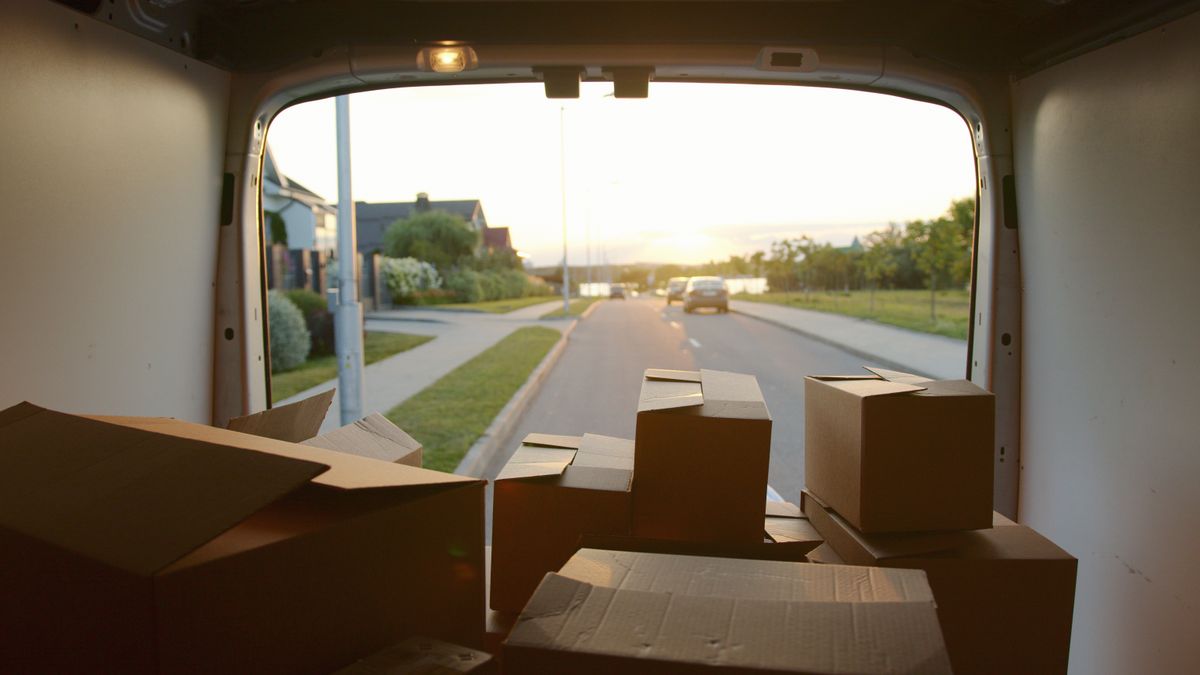
Quick answer
Movers load a truck in tight vertical tiers, starting at the front wall and working back. The heaviest, sturdiest items go on the floor and toward the front, boxes stack on top by weight, and light items fill the gaps. Everything is padded, and each tier is strapped to the truck walls before the next begins.
In this guide
- Why loads shift and what it costs
- Before loading: pad, wrap, take apart, and seal
- How movers load a truck in tiers
- What to load first in a moving truck
- Moving truck weight distribution
- Moving blankets and straps: locking each tier in place
- What goes on the truck last
- How to load a moving truck yourself
- Frequently asked questions
Why loads shift and what it costs
A moving truck brakes, turns, climbs hills, and hits potholes. Every one of those motions pushes on the load. If there is empty space, things slide into it. If something heavy sits on something weak, the weak thing gives way. And if two bare surfaces touch, hours of road vibration rub the finish off both.
Almost all damage in transit comes from those three causes: space, weight in the wrong place, and unprotected contact. How movers load a truck is a set of habits that remove all three. The goal is a load so tight that it behaves like one solid block.
Before loading: pad, wrap, take apart, and seal
Loading starts inside the house. An item that is not ready does not go on the truck.
- Furniture is wrapped in moving pads so no wood, glass, or painted surface is exposed
- Stretch wrap or tape goes over the pads, never directly on a finished surface, to hold them in place and keep drawers and doors shut
- Large pieces are taken apart. Bed frames, table legs, and dresser mirrors come off, and the hardware is bagged and attached
- Boxes are closed, taped, and full. A half-empty or open box crushes when weight goes on it. A properly packed box is a building block
- Mattresses and upholstery are bagged or wrapped to keep them clean
This is why well-packed boxes matter so much to the load. If you want them packed for you, our packing services include the boxes, paper, bubble wrap, and tape in the quote.

How movers load a truck in tiers
Professional movers do not fill the floor first and then pile things on top. They build tiers: vertical sections a few feet deep that run from wall to wall and from the floor to the ceiling. The first tier goes against the front wall of the cargo area, behind the cab. When it is finished and secured, the next one is built against it, and so on to the back door.
Each tier is built like a stone wall:
- Base. The heaviest and sturdiest items sit on the floor: appliances, dressers, chests, filing cabinets, and the heaviest boxes
- Middle. Medium-weight boxes and solid furniture are stacked on the base, with heavier boxes below lighter ones and box edges lined up so the weight carries straight down
- Top. Light boxes and light, crushable items go in the space under the ceiling: lampshade boxes, cushions, bagged bedding, and plastic toys
- Gaps. Any hole in the wall is filled with something soft or small so nothing can move sideways
A finished tier is flat across its face, which gives the next tier something solid to lean against.
What to load first in a moving truck
| Where | What goes there | Why |
|---|---|---|
| Front wall, on the floor | Refrigerator, washer, dryer, heavy dressers | Keeps the most weight low and forward |
| Along the side walls, on edge | Mattresses, box springs, headboards, table tops, large mirrors and pictures in cartons | Flat items ride best upright and can be tied to the wall |
| Middle tiers | Boxes in tight rows, bookcases, desks, chairs | Uniform shapes build stable walls |
| On end, where the piece allows | Sofas and loveseats, fully padded | Saves floor space and locks the tier together |
| Top of each tier | Light boxes, cushions, bedding | Nothing heavy is ever above something fragile |
| Back of the truck | Odd shapes, outdoor items, things needed first | Last on is first off |
Mattresses do double duty. Stood on edge, they make good padding between a tier and a row of framed pictures or a glass table top in its carton.
Have a trained crew load your truck, or let us handle the whole move. Get a free, no-obligation quote.
Moving truck weight distribution
Where the weight sits changes how a truck drives. Three rules cover most of it:
- Low. Heavy items go on the floor. Weight up high raises the center of gravity and makes the truck lean in turns
- Forward. The heaviest items go toward the front of the cargo area, not behind the rear axle. Too much weight at the very back makes the steering feel light and the ride unstable
- Even side to side. A refrigerator on one side is balanced by a washer and dryer or heavy boxes on the other, so the truck sits level
Good moving truck weight distribution also protects your belongings. A truck that rides level and steady shakes its load less.
Moving blankets and straps: locking each tier in place
Tight stacking is half of the job. Tying off is the other half. Truck bodies made for moving have rails or slats along the walls for that purpose. After every tier or two, straps are run across the face of the load and anchored to the walls, so each section is held on its own. If the truck stops hard, one tier cannot push into the next.
Moving blankets and straps work together. The pads prevent rubbing between pieces, and the straps prevent movement. Straps are snugged down over padded surfaces or boxes, never across bare wood or glass, and never so tight that they crush what they hold.
If the load does not reach the back door, the last tier is tied off or braced, so it cannot tip backward into the empty space when the truck climbs a hill.
What goes on the truck last
The last items loaded are the first ones off, so the back of the truck is saved for things you will want right away at the new home:
- Area rugs, so they can go down before the furniture comes in
- The vacuum, a broom, and basic cleaning supplies
- The tool kit and the bags of furniture hardware
- Bed frames and mattresses for the first night, when the load allows
- Boxes marked open first
Ladders, grills with the propane tank removed, bicycles, and other awkward shapes usually ride at the back as well, where they are not under any weight.
How to load a moving truck yourself
If you are loading a rental truck on your own, the same rules apply at any size:
- Get more moving pads than you think you need, plus several ratchet or cam straps
- Put the appliances and heaviest furniture against the front wall, balanced left to right
- Build one tier at a time, floor to ceiling, and strap it before starting the next
- Stack boxes heavy to light and keep the rows tight
- Stand mattresses, mirrors, and table tops on edge along the walls
- Fill every gap with something soft
- Tie off the last tier so nothing can fall toward the door
If you would rather drive the truck but not build the load, that is a service we offer. Allpoints provides labor-only help, including loading or unloading a rental truck or container. For a full-service local move or long-distance move, the crew and the truck come together. Either way, request a free quote, and see our moving tips for more.
Key takeaways
- Loads shift because of empty space, weight in the wrong place, and unprotected contact
- Movers build floor-to-ceiling tiers from the front wall back, one at a time
- Heavy items go low, forward, and balanced side to side. Light items go on top
- Every piece is padded and each tier is strapped to the truck walls
- The last items on are the first off, so rugs, tools, and first-night items go at the back