Quick answer
To pack books for moving, use small, sturdy boxes with the bottom seam taped twice. Pack books flat, upright with the spine against the side of the box, or spine down, but never with the spine facing up. Fill gaps with paper, keep every box light enough to lift comfortably, and label it.
In this guide
- Thin the collection before you pack a single box
- The best boxes for moving books
- How to pack books for moving, step by step
- Packing books flat or upright: the positions that work
- How heavy should a box of books be
- How to pack hardcover books, rare editions, and oversized volumes
- Lifting, stacking, and loading book boxes
- When to hand the library to movers
- Frequently asked questions
Thin the collection before you pack a single box
Books are dense. Moving a book collection means lifting every volume at least twice, and on a long-distance move every box adds to the inventory your price is based on. Sorting first is the cheapest packing you will do.
- Keep what you will read again, use for reference, or would miss
- Donate or sell duplicates, outdated textbooks and manuals, and books you finished and did not love
- Set aside the few you are reading now. They go in your own bag, not in a box
Libraries, schools, and thrift stores often take books in good condition. Our guide to decluttering before a move has a simple way to make the keep-or-go decisions quickly.
The best boxes for moving books
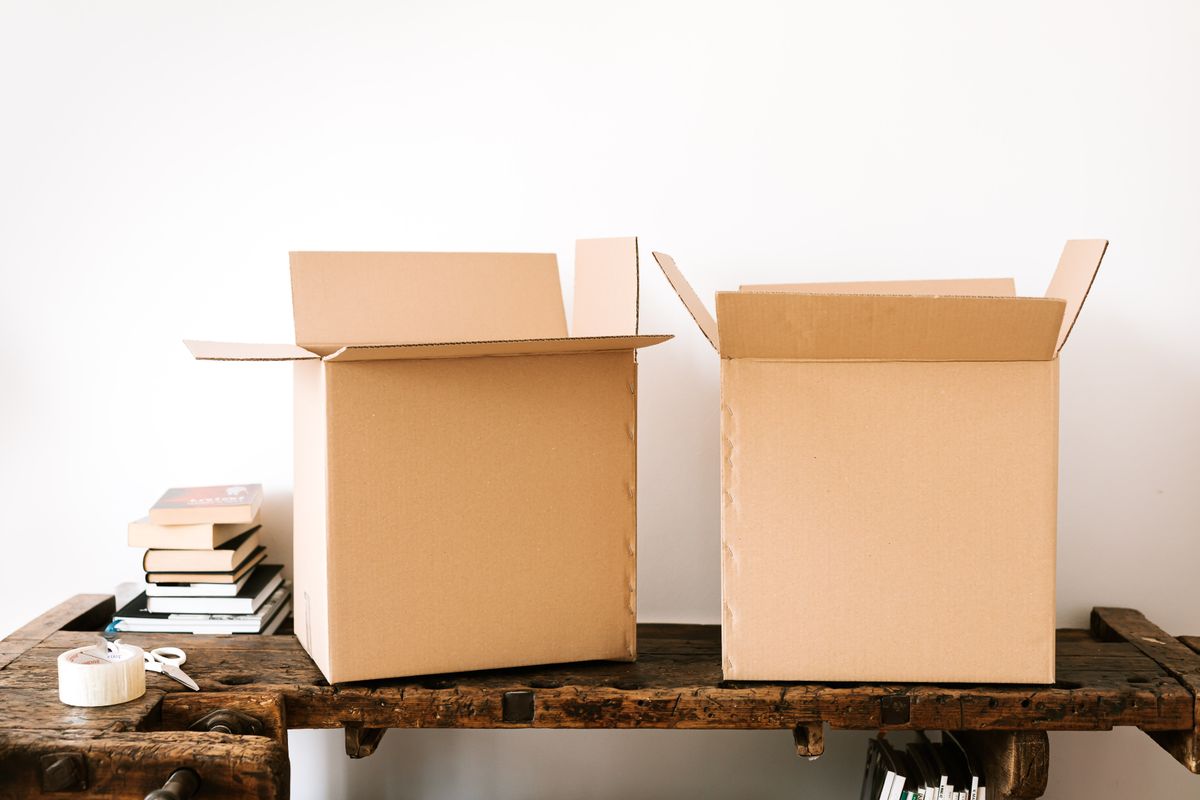
The best boxes for moving books are the smallest moving boxes you can buy. They are often sold as book boxes for exactly this reason: filled to the top with books, a small box is still liftable. A large box of books is not, and its bottom may not hold.
- Small boxes, new or clean and dry. Skip any box that is soft, torn, or has been damp
- Packing tape. Good tape, not masking tape
- Plain packing paper to line boxes and fill gaps
- A thick marker
Sturdy boxes made to hold bottles work well too, and our post on where to find free moving boxes lists places to ask. A rolling suitcase is another good home for heavy books, since the wheels do the carrying.
Not sure how many boxes you need? The packing estimator gives a count for a home your size. Add extra small boxes if you have full bookcases.
How to pack books for moving, step by step
- Build the box properly. Fold the flaps flat and run two strips of tape along the bottom seam, then one across each end. Do not rely on interlocked flaps
- Line the bottom with a sheet or two of packing paper
- Group by size. Books of similar height and width pack tighter and protect each other
- Put the heaviest books in first, on the bottom
- Pack snug, not jammed. Books should not slide, but you should not have to force the last one in
- Fill every gap with crumpled paper so nothing shifts or leans
- Add a sheet of paper on top, close the flaps flat, and tape the top seam
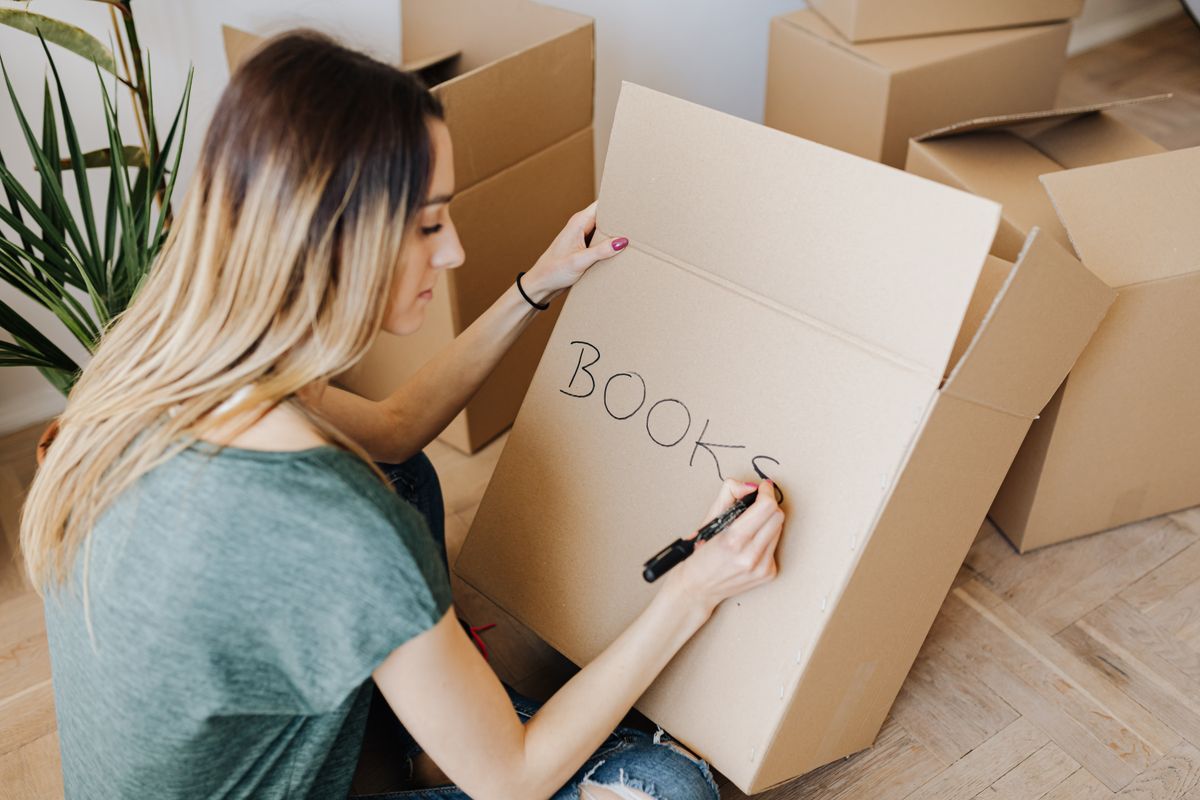
- Label two sides: BOOKS, the room, and what is inside, such as cookbooks or office shelf two
Pack books early. Most of them can be boxed two to four weeks before the move without anyone missing them.
Packing books flat or upright: the positions that work
There are three safe ways to place a book in a box, and you can mix them to fill the space.
- Flat, in stacks, largest on the bottom. Best for heavy and oversized books
- Upright, standing as it would on a shelf, with the spine against the side of the box
- Spine down, with the page edges facing up
The one position to avoid is spine up, with the page edges facing down. The weight of the pages pulls away from the binding, and a bumpy ride can loosen it. Also avoid wedging books in at an angle, which warps covers.
When you stand two rows in one box, place them spine to spine or put paper between them so covers do not rub.
Too many shelves and not enough weekends? Our crew can pack, carry, and load the whole library for you.
How heavy should a box of books be
Light enough that you can pick it up from the floor, carry it across the room, and set it down without straining. If you have to brace yourself to lift it, it is too heavy, and it is too heavy for whoever carries it next.
A small box filled with paperbacks is usually fine. A small box of hardcovers, textbooks, or art books can be heavier than you expect. Test each box before you tape it. If it fails the test, take a few books out and fill the space with something light, such as paper, towels, or a pillow.
Never fill a medium or large box with books. If small boxes run out, fill a medium box no more than halfway with books and top it off with light items.
How to pack hardcover books, rare editions, and oversized volumes
Hardcover books: Pack them upright or flat with books of the same size. Leave dust jackets on, and slip a sheet of paper between any covers that might stick or scuff.
Rare, old, or sentimental books: Wrap each one in plain paper before boxing. Put a piece of stiff cardboard between books with fragile spines. Do not use newspaper, and do not leave these boxes in a hot attic, a garage, or a damp basement at either end of the move. If a few books are truly irreplaceable, carry them with you.
Oversized and art books: Lay them flat on the bottom of the box, one or two to a box if they are heavy, and build up around them.
Photo albums and scrapbooks: Pack them flat, with paper between albums, and keep them with the things you move yourself if you can.
Lifting, stacking, and loading book boxes
- Lift with your legs. Squat, hold the box close to your body, and stand up. Turn with your feet, not your waist
- Use wheels. A hand truck moves a stack of book boxes in one trip
- Stack low. Book boxes go on the bottom of any stack, with lighter boxes on top
- Stage them near the door, off to one side, so nobody has to carry them across the house on moving day
- Empty the bookcases completely. Take out adjustable shelves and bag the pegs
In the truck, book boxes make a solid base layer on the floor. More on that in how movers load a truck.
When to hand the library to movers
A few shelves are an easy evening. A wall of bookcases, a home office full of binders, or a move with stairs is where help pays for itself. Uniform, well-taped small boxes load quickly, which matters on an hourly local move. On a long-distance move, a thinned-out collection keeps the inventory down.
If you would rather not pack them at all, our packing service covers books along with the rest of the house, and the boxes, paper, and tape are included in the quote.
Key takeaways
- Sort first. Every book you donate is one you do not lift twice
- Use small boxes and tape the bottom seam twice
- Pack flat, upright, or spine down, never spine up
- If a box is a strain to lift, take books out and fill the space with something light
- Book boxes go on the bottom of every stack